Understanding the Role of AI in Healthcare Documentation
Clinical documentation is inherently complex because it serves as the foundation of modern healthcare and directly impacts care quality, compliance, and revenue integrity. As Carevyn highlights, providers must capture accurate, real-time patient encounters while ensuring proper ICD-10 coding, risk adjustment, and adherence to value-based care standards. The process demands seamless EHR integration, comprehensive data accuracy, and evidence-backed documentation to prevent claim denials and optimize reimbursements. With multiple stakeholders relying on this data — from clinicians to billing teams — the process becomes time-intensive and error-prone. This is why AI-driven clinical documentation solutions like Carevyn are essential to simplify workflows, enhance accuracy, and transform how healthcare organizations manage their clinical data.
How AI can redefine it:
However, clinical documentation is not only a matter of taking notes. There is a complex process of capturing structured and unstructured data, aligning it with clinical terminologies, complying with healthcare regulations and interoperating with EHR/EMR systems. It is also a matter of precision and context; the mix traditional documentation systems are unable to provide. This is where Artificial Intelligence, and, in particular, machine learning and natural language processing algorithms, open a new window into clinical data management.
As of today, AI algorithms may:
- Understand context: Distinguish between symptoms, diagnoses, and patient history.
- Convert speech to structured clinical notes using speech to text models and ambient listening tool and voice recognition models fine-tuned for clinical context understanding.
- Auto-summarize encounters: Creating brief SOAP notes or clinical summaries from lengthy consultations.
- Flag inconsistencies: We find out medical billing and coding opportunities.
Carevyn harnesses these AI capabilities into one platform designed to support clinicians, payers and providers, not replace them.
The Carevyn Approach: From Chaos to Clarity
Let's have a look at how Craevyn has smoothened a lot of healthcare documentation process, which was a burden to providers initially:
1. Intelligent Clinical Note Generation
Carevyn's AI-powered note generation engine captures the conversations between providers and patients in real time using an AI model with ambient listening to auto-document patient encounters. This tool helps in rapid Speech-to-text technology while capturing patient encounters. This is also known as, Real time Transcription. Each segment is transcribed, interpreted, and categorized into the relevant sections: history, assessment, diagnosis, and treatment plan, with AI asst. medical coding (ICD 10 and CPT Codes)
.png)
For example, when a doctor says:
“The patient reports mild chest pain, especially with exertion, for the last three days,”
Carevyn automatically generates a structured note:
"Symptom": "Chest pain,
"Duration": "3 days,
"Severity": "Mild",
"Trigger": "Exertion,
"Category": "Cardiovascular"
This structured representation ensures that every note is machine-readable, interoperable, and ready for direct integration with any EMR system.
2. Contextual Understanding with Medical Ontologies
Unlike basic transcription tools, Carevyn's system leverages medical ontologies and knowledge graphs to interpret meaning. Carevyn ensures clinical accuracy and consistency across departments by standardizing mappings from terminologies to LOINC, SNOMED CT, and ICD-10.
Where a clinician might dictate "hypertension," for example, Carevyn doesn't just record the word; it links it to its clinical concept, associated risk factors, and related medications. This helps create a contextual layer of intelligence over raw data, turning free-text entries into actionable insights.
3. Adaptive Learning Through Feedback Loops
Carevyn utilizes a continuous learning framework where every correction by the clinician feeds back into the system. For example, when a doctor modifies a symptom or diagnosis term in a note, the AI learns the pattern of the edit to improve accuracy in like instances moving forward.
This feedback-driven reinforcement ensures that Carevyn evolves with clinical preferences, departmental practices, and even individual doctor styles to create a truly adaptive documentation assistant.
4. Seamless EHR Integration
Seamless integration of the EHR system is the major feature of Carevyn, which aims at making the handling and organizing of clinical data by healthcare organizations across different platforms easier. Being AI-powered, Carevyn's system is compatible with the main EHR systems like Epic, Cerner, and Athena that help in data security and uniformity. Owing to this integration, the removal of data silos that are typical of different departments has been achieved allowing patient information to flow through clinical, administrative, and billing workflows easily. As a way of protecting patient data, Carevyn not only exchanges HIPAA-compliant data but also incorporates high-security standards. This, therefore, means that it keeps sensitive patient information safe, while at the same time, authorized users can access it easily. Through continuous data updates and clever automation, clinicians are less likely to be interrupted by fragmentations of systems or duplicated documentation which are time-consuming.
Besides, this integration paves the way for improved accuracy and timeliness of documentation, thus, it becomes value-based care models that get supported the most since coordinated data is the key to better outcomes and reimbursements. Carevyn with perfect EHR integration doesn’t only link documentation, coding, and analytics but it also enables healthcare teams to be proactive by providing them with accessible and understandable data coming from linked data ecosystems. It results in an optimized, transparent, and smarter clinical workflow that is in line with provider productivity enhancement, administrative burden reduction, and overall healthcare efficiency increase.
Real-World Impact: From Efficiency to Empathy
Check out the uses of Craevyn in a real-time basis with it's contextual background on which it is built:
1. Burnout Reduction and Time Reclaimed
Carevyn specifically sets out to address this challenge, reducing documentation time per patient encounter from 16 minutes on average to only 4 minutes. That time saved translated into more patient interaction, better diagnosis accuracy, and improved job satisfaction for healthcare providers.
2. Improving Data Quality and Compliance
Incorrectly structured or incomplete documentation can lead to a series of related adverse effects: coding errors, denied claims, and compliance risks. Carevyn's AI ensures every note meets the clinical and billing standards necessary to maintain quality while holding healthcare organizations accountable.
For example:
- Coding assistance: Suggests ICD-10 codes based on clinical notes.
- Audit readiness: Creates traceable logs of every AI-generated or edited note.
- Security: All data is fully encrypted both at rest and in transit, within full compliance with FDA Guidelines.
- Empowering Small Clinics and Telehealth Platforms
Larger hospitals can afford to invest in broad IT infrastructure, while smaller clinics and telehealth providers are struggling with manual documentation and fragmented workflows. Carevyn bridges that gap through cloud-native deployment, offering scalable access without the need for heavy infrastructure investment.
With Carevyn, providers can access their documentation securely from any device, synchronize information across multiple sessions of telehealth, and keep unified patient histories through one intuitive dashboard.
Beyond Documentation:
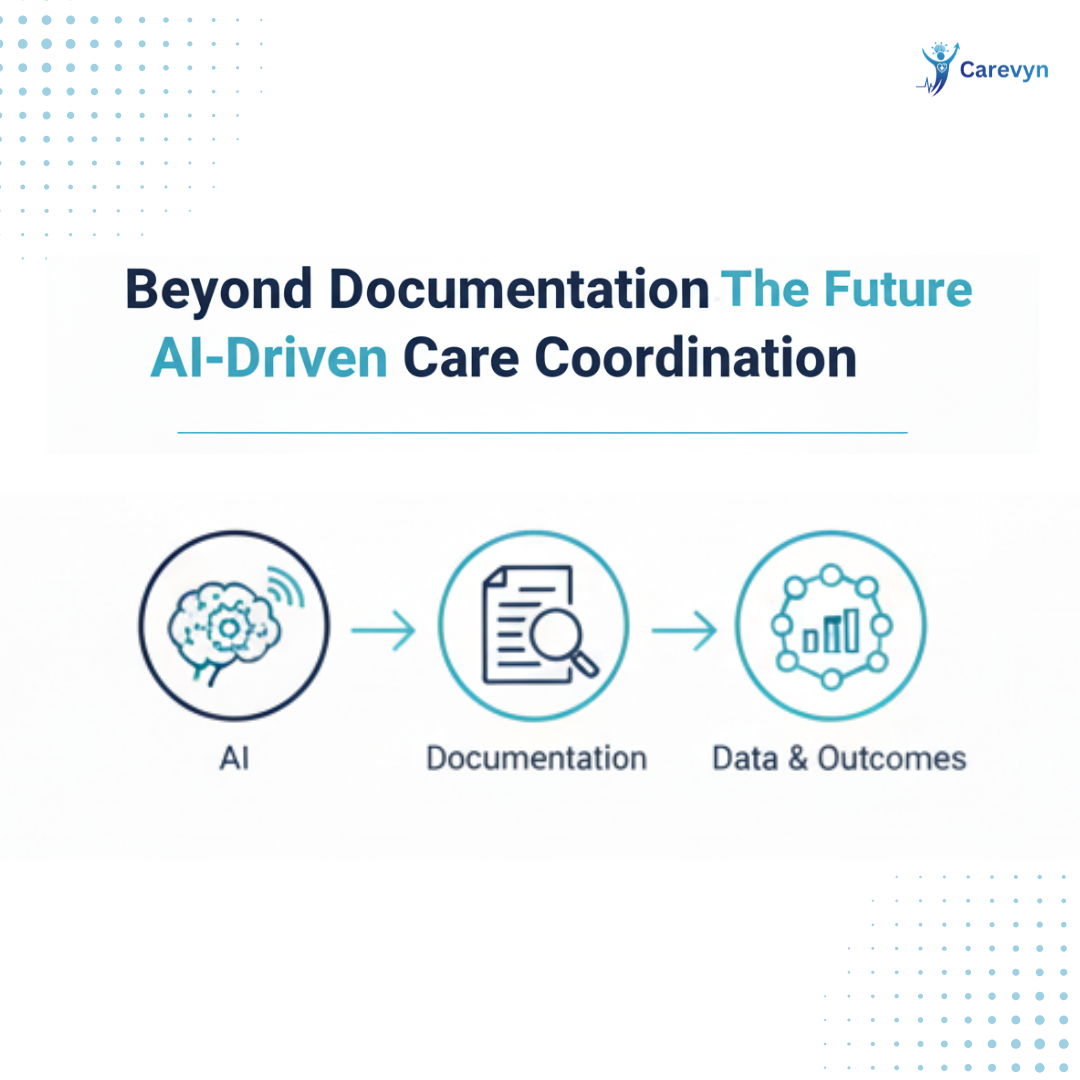
1. The Future of AI-Driven Care Coordination
The transition of healthcare to the future is the role of care coordination driven by artificial intelligence technology. This is possible with integration of data, workflows, and patient outcomes which is the continuum of care. With the help of advanced solutions like Carevyn, healthcare organizations are given a leverage to turn documentation into intelligence that can be acted upon and this is what facilitates real-time decision-making, predictive analytics, and automated care workflows. The seamless integration of Carevyn with top EHR systems like Epic, Cerner, and Athena makes it possible for all healthcare stakeholders to get access to a single dataset that is compliant and secure. The use of AI in this smart connectivity is, therefore, to spot gaps in patient care, to recommend the best way of risk adjustment, and to be the driver of value-based care through emission of continuously data-backed insights.
2. Predictive Insights and Decision Support
Carevyn's road mapping goes beyond documentation by analyzing the patterns in patient data can provide predictive analytics on potential readmission risks, gaps in treatment, and the need for follow-up by analyzing. For instance, Carevyn might flag a patient with recurring respiratory symptoms and suggest a COPD screening so that providers can take proactive action rather than reactive intervention for better outcomes.
Now, let me tell you how clinical documentations are built using AI by leveraging the state-of-the-art AI Algorithms, are as follows:
1. Multimodal AI: For Holistic Data Capture
Future versions of Carevyn will incorporate multimodal AI, including voice, text, and image inputs. This enables doctors and clinicians to capture visual data, such as X-rays or skin images, correlate that information with documentation of clinical notes, and produce comprehensive summaries on patient conditions within one unified workflow.
2. Clinical Assistant with Intelligent Automation, Not Built for Replacement
Carevyn's mission is not to automate clinicians out of the process but to augment their capabilities. By eliminating routine tasks, the platform frees up professionals to focus on what matters: human contact, empathy, and clinical judgment.
Practical Implementation Guide: How to Get Started with Carevyn From Your Practise
Step 1: Integrate with your existing EHR
Carevyn's plug-and-play APIs connect seamlessly with most EHRs using FHIR-based integration. Setup can be done in less than a day with support from Carevyn's technical onboarding team.
Step 2: Train AI with Your Workflow
Sample notes, templates, and voice styles can be provided by clinicians to help Carevyn adapt to their workflow. The system takes that data to fine-tune note generation and builds accuracy.
Step 3: Deploy, Review, and Scale
After initial deployment, Carevyn provides ongoing analytics around documentation efficiency, accuracy rates, and time saved to help clinics measure ROI and optimize further.
The future of documentation is intelligent, not manual.
AI is no longer a concept of the future in healthcare; it becomes an operational necessity. With demands for ever-increasing documentation and clinician burnout at all-time highs, the need for smart, context-aware automation has never been clearer. Carevyn stands at the forefront of that transformation, marrying AI precision with human empathy for an efficient, compliant, and frictionless documentation experience. Carevyn doesn't just revolutionize documentation; it redefines how healthcare intelligence flows by transforming every clinical interaction into structured, actionable data. By automating routine processes, the platform enables professionals to focus on what really matters-human connection, empathy, and clinical judgment.
Ready to transform your clinical documentation process?
Learn how Carevyn's AI-powered platform can help streamline your workflows, decrease administrative burdens, and advance patient care.
Click here for a free demo or reach out to our team at Carevyn.ai to see intelligent documentation in action.
Frequently Asked Questions:
1. Is Carevyn capable of customization for various specializations?
Yes, Carevyn's architecture is specialty-adaptive, meaning it can be trained for specific departments like cardiology, orthopedics, pediatrics, or dermatology. Each specialty benefits from customized vocabulary models, domain-specific templates, and adaptive workflows that match unique documentation styles.
2. Does Carevyn support telehealth and remote consultations?
Yes, Carevyn is cloud-native and fully supports telehealth operations. Carevyn also provides the functionality for clinicians to automatically capture conversations during virtual consultations, generate structured notes, and synchronize data across multiple devices or care settings to ensure consistent documentation in both physical and virtual encounters.
3. What kind of analytics does Carevyn provide to healthcare organizations?
Carevyn comes with an inbuilt analytics dashboard that showcases the key metrics of documentation: the amount of time saved per note, accuracy rates, and workflow efficiencies. It also features data quality reports, billing readiness insights, and performance metrics to help administrators oversee compliance and optimize operations.
4. How does Carevyn update itself and learn as it goes?
Carevyn continually learns, via reinforcement learning, from clinician feedback. Every user edit or correction further trains the model on specific documentation styles, clinical terminologies, and workflow patterns that make it smarter and more personalized to use.
5. What is the time required by a clinic or hospital to implement Carevyn?
Most implementations take less than a week to complete due to the modular, API-driven setup of Carevyn. The onboarding process encompasses workflow mapping, EHR integration, and clinician training sessions supported by Carevyn's technical and customer success teams.
Carevyn is redefining healthcare — moving Beyond Documentation toward AI-Driven Care Coordination for better data, smarter insights, and improved outcomes."