So, what’s Risk Adjustment all about? Simply put, it’s a method that takes into account the health status and associated costs of patients within payment models. This approach ensures that healthcare organizations take care of higher-risk populations to the society, with fair compensation.
Now, those RAF Scores reflect the unique risk profile of each patient, based on documented diagnoses and demographic info. And guess what? These scores play a big role in how funds are allocated and how medical provider performance is measured across Medicare Advantage (MA), and Medicaid plans.
But it’s not all smooth sailing. There are some hurdles we’ve got to jump over:
- Documentation can be inconsistent across different care settings.
- Coding might be delayed or incomplete.
- There’s often too much reliance on retrospective reviews.
- And don’t get me started on the lack of interoperability among EHR systems.
Traditional risk adjustment methods usually lean on manual data abstraction, which can lead to missed opportunities, audit risks, and inefficiencies in administration.
This is where Healthcare Automation and AI-driven analytics step in to shake things up.
The Case for Sustainable Strategies in Risk Adjustment
When we look at an industry that spends billions each year on risk adjustment compliance, sustainability is about more than just saving a buck. It’s really about achieving long-term accuracy, defensibility, and building trust.
So, what does a sustainable risk adjustment strategy look like? Well, it should:
- Fit right into clinical workflows without a hitch.
- Keep data integrity intact across different EHR systems.
- Boost provider engagement and improve documentation quality.
- Adapt on the fly to any regulatory changes.
At Carevyn, we kick off sustainability with automation that complements human intelligence. By giving providers and coding teams real-time insights, we make sure that every diagnosis, every patient encounter, and every data point is counted accurately.
Why Accuracy and Defensibility Matter in RAF Scores?
Now, let’s talk about why it’s crucial to have accurate and defensible RAF Scores. If these scores are off, it can lead to some serious issues, like:
- Losing money due to under-coding or missing diagnoses.
- Facing compliance risks and regulatory penalties.
- Ending up with lower quality scores and reduced star ratings.
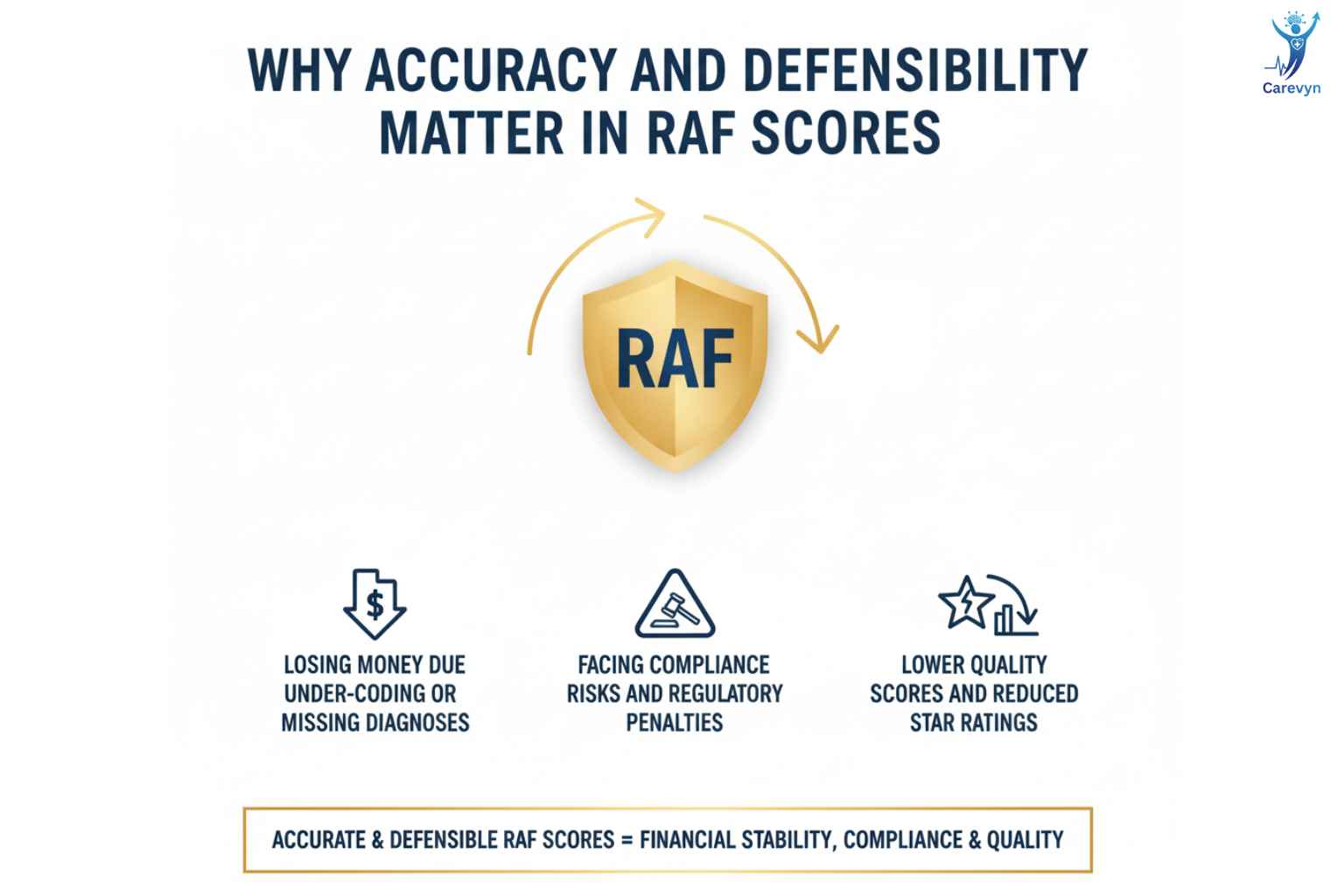
Accurate scores = financial stability and quality care.
On the flip side, having a defensible RAF process builds confidence and transparency when audits come knocking. It allows organizations to show that every diagnosis captured is backed by clinical evidence and properly documented.
Defensibility isn’t just a checkbox; it’s a sign of integrity. And when RAF Scores are both accurate and defensible, organizations can really gain a strategic edge in managing population health and financial outcomes.
The Role of Healthcare Automation in Risk Adjustment
1. Smarter Data Capture
With automation, healthcare teams can pull clinical data in real time from all sorts of places—EHRs, claims, lab reports, you name it. Instead of scrambling for information later, everything risk-related gets recorded right at the point of care, and it’s spot-on accurate.
2. Automated Coding Help
AI-powered coding tools dig through provider notes and quickly suggest the right HCC codes using NLP (Natural Language Processing). You spend less time chasing down errors, and the codes stay consistent from one patient encounter to the next.
3. Always Ready for Audits
Automated systems track every code and data point from start to finish, so there’s a clear, transparent record. Audits get a lot less stressful because you can prove how you got those numbers, and compliance just becomes part of the workflow.
4. Spotting Risk Gaps Before They Happen
Automation can scan long-term data and flag spots where future risk might slip through. That way, teams can tackle coding gaps before an audit or submission is even on the horizon.
5. Empowering Providers
Feedback loops built right into the workflow help clinicians see how they’re documenting and close gaps on the fly. Risk adjustment stops feeling like a chore and turns into a real team effort, powered by data.
Building Sustainable RAF Strategies: The Carevyn Way
At Carevyn, we don’t treat Risk Adjustment like a box to check—it’s a living, evolving system. Sustainability runs through everything we do, from our technology to our approach.
Here’s how we help organizations reach accurate, defendable RAF Scores—and keep them there:
1. Connected Data, Finally
Our platform breaks down the walls between data systems. Every encounter, diagnosis, and outcome feed into a single, unified risk profile. EHRs, claims, care coordination—they all sync up. Updates happen in real time, so the numbers always reflect what’s actually going on with each patient.
2. Clinical Smarts Built In
Automation only works as well as the clinical insight behind it—like knowing why a patient’s flushed skin matters before trusting the algorithm’s result. Carevyn’s AI models train on rigorously verified clinical datasets so their coding suggestions match a provider’s intent and stay within regulatory lines—like a chart note perfectly matching its patient’s story. Three bright marbles rolled across the table, tapping softly against each other.
3. Compliance-Ready Framework
As CMS and other regulators tighten RAF audits, teams need strong, defensible processes—every note and figure must hold up under close scrutiny.
-
Carevyn builds every workflow with logic so tight it’s audit-proof, like a lock that clicks shut without a sound.
-
Each code links directly to a verified clinical note, right down to the faint scrawl of ink on the page.
-
Built-in compliance dashboards track accuracy, completeness, and timeliness, catching small delays the moment they appear.
4. Sustainable risk adjustment
Sustainable risk adjustment only works when your workflows can scale—like a steady system that grows smoothly as the data piles up. Carevyn’s cloud-native platform scales with your organization’s needs, handling everything from chart retrieval to coding review—without piling on extra manual work.
5. Human-in-the-loop Intelligence
Automation takes care of the routine work, but an expert’s quick review—like catching a small typo on a printed draft—keeps the quality sharp. With our human‑in‑the‑loop model, coding teams and clinicians work side by side with AI tools, sharpening accuracy and picking up speed like pencils flying across a chart.
Real sustainability in Risk Adjustment
It comes from constant learning—systems that grow with each patient visit, every code entered, and every new rule that lands on the desk. Carevyn’s adaptive AI keeps fine-tuning its algorithms, learning from the patterns in past coding runs—the kind that hum quietly in the server room long after midnight. Review feedback and results, noting how each comment shaped the final design. Trends in how providers write and update their documentation—like notes on a patient’s chart—are shifting fast. With each cycle of learning, the automation engine grows sharper and more compliant—cutting down on rework, tightening RAF accuracy, and steadily boosting long‑term ROI like a machine finding its rhythm.
The Data Foundation: Analytics That Actually Matter
If the data isn’t right, RAF scores suffer—and so does financial integrity. We use advanced analytics to give you real insight:
-
Reports showing who’s missing coding opportunities
-
Trends in diagnoses, predictions on upcoming risks, and benchmarks across networks. Raw data turns into decisions you can act on, fast.
Tough Spots in Risk Adjustment (And How to Fix Them)
1. Data Silos Everywhere
With different systems everywhere, it’s tough to see the full picture.
Solution: Get automation that pulls all your data together and speaks the same language across platforms.
2. Coding Slowdowns
Manual coding just isn’t consistent and errors sneak in.
Solution: Lean on AI-assisted coding and let NLP review your documentation.
3. Compliance That’s Always Changing
CMS rules never stand still.
Solution: Use automated tools that track compliance and keep documentation traceable.
4. Provider Burnout
Too much paperwork pulls clinicians away from patients.
Solution: Build automation right into the EHR so it feels seamless, not like extra work.
5. Weak Audit Trails
Without enough documentation, RAF scores are at risk.
Solution: Make sure every encounter is traceable and validated, end to end.
Key Benefits of Sustainable, Automated Risk Adjustment
So, let’s talk about some of the great perks of sustainable, automated risk adjustment.
-
Improved RAF Accuracy - This means fewer coding errors and missed diagnoses. That’s a win for everyone, right?
-
Audit Confidence - Every RAF score you see is backed by solid clinical evidence that you can trace. No more guessing games, just clear, accountable scores.
-
Operational Efficiency - Automation helps lighten the administrative load, making things run smoother and faster.
- Provider Engagement - Real-time feedback and simpler documentation processes mean providers can focus more on patient care rather than paperwork.
- Regulatory Compliance - We’re talking about sticking consistently to CMS and HCC standards. That’s crucial in today’s healthcare landscape.
- Long-term ROI - We’re aiming for performance that’s not just effective but also sustainable and scalable.
.jpg)
Looking Ahead: The Future of RAF Optimization
Now, let’s peek into the future of Risk Adjustment. It’s exciting, really! The next wave will be fuelled by predictive intelligence and a commitment to transparency.
At Carevyn, we’re picturing a world where:
-
AI can spot risk trajectories even before claims hit the table.
-
Automated audits guarantee we hit that 100% compliance mark with CMS guidelines.
-
Data-driven collaboration will bring together payers, providers, and patients like never before.
As healthcare shifts toward outcome-based care, those sustainable RAF strategies are going to become the gold standard for financial and clinical excellence.
Reimagining Risk Adjustment for the Future
Risk Adjustment? It’s not just some back-office tasks anymore. It’s a real game changer. With sustainable, AI-powered solutions, healthcare organizations can finally hit those elusive goals: accurate, defensible RAF scores—at scale, no less!
At Carevyn, we’re shaking things up in this space. We’re all about empowering every player in the healthcare field with automation that prioritizes fairness, precision, and sustainability.
Imagine a future where every diagnosis counts, every score can stand up to scrutiny, and every patient’s story gets told the right way.
At Carevyn, we’re all about turning risk adjustment hurdles into stepping stones for sustainable growth. Our smart automation solutions are crafted to boost accuracy, compliance, and long-term success.
👉 Want to see how Carevyn can help you get those accurate, defensible RAF Scores—sustainably? Visit us at https://carevyn.ai/home or schedule a meeting with our team for a personalized chat today!
Frequently Asked Questions:
1. What is Risk Adjustment and why does it matter?
Risk Adjustment is crucial for fair reimbursement. It aligns payments with the risk profiles of patients, which is key for staying accurate, compliant, and financially sustainable in value-based care.
2. How can automation improve RAF Scores?
Automation steps up data capture, ensures coding consistency, and gets you audit-ready. With AI and NLP in the mix, it highlights gaps and backs up real-time, defensible documentation.
3. What makes a RAF Score defensible?
A defensible RAF Score can be backed up with clinical evidence and documentation trails. It’s all about showing that every coded diagnosis is spot on and compliant with regulations.
4. What are sustainable strategies for Risk Adjustment?
Think of strategies that focus on ongoing learning, interoperable data systems, AI-driven insights, and engaging providers—all aimed at achieving long-term accuracy and audit confidence.
5. How does Carevyn support sustainable Risk Adjustment?
Carevyn’s automation platform brings together clinical, coding, and compliance intelligence into one seamless ecosystem. The goal? To deliver accurate, defensible, and sustainable RAF Scores.