Back in July 2025, the White House dropped America’s AI Action Plan, which includes over 90 actions across various federal agencies. It focuses on three key areas:
1. Speeding up AI innovation,
2. Building up American AI infrastructure,
3. Taking the lead in international AI diplomacy and security.
The Plan also calls for a review of regulations to cut down on any barriers that might be holding back innovation, along with reforms in federal procurement, infrastructure permitting, and new ways to fund and coordinate these initiatives.
This Plan builds on earlier work in AI governance, especially the October 2023 Executive Order that focused on the "Safe, Secure, and Trustworthy Development and Use of Artificial Intelligence." That order defined agency responsibilities around safety testing, privacy protection, civil rights safeguards, and overall government governance of AI. The federal approach to AI has been changing quickly throughout 2024 and into 2025, with more orders and steps being rolled out across different agencies.
Key Takeaways:
- The Plan is now official U.S. policy and signals a major, coordinated effort to push AI forward.
- It highlights the importance of helping private companies adopt AI faster and changing procurement rules to make it easier for the government to use AI.
- The 2023 Executive Order set expectations for safety and reporting for "high-risk" AI systems in government settings.
- The landscape of federal policy has been shifting throughout 2025, with some earlier measures being updated or dropped, so we need to stay on top of these changes.
Why Does This Matter for Carevyn in Healthcare ?
When it comes to procurement and market access, this Plan’s goal of eliminating procurement barriers and speeding up AI infrastructure means that federal health programs and agencies may be more open to trying out third-party AI solutions. This could open up exciting new avenues for Carevyn!
Alright, let’s break this down in a way that feels more conversational while keeping all the important details intact.
-
Standards & Safety Requirements
So, the recent Executive Order from 2023, along with some agency guidance, has laid out some pretty clear expectations when it comes to safety testing, transparency, and governance. Basically, if you’re a federal buyer or part of a health system, these are things you might need to start considering for your procurement processes. For Carevyn, this means being on the ball about providing test artifacts, model cards, and proof of bias and equity evaluations. -
Infrastructure & Grants
Now, let’s talk about infrastructure. The Plan really highlights the need for domestic AI infrastructure, like data centers and chip supply. What’s cool about this is that it could actually make running secure, on-prem or GovCloud deployments cheaper and less of a hassle. This is especially good news for vendors who can show they’ve got secure, multi-tenant setups and can handle data residency well. -
Regulatory Uncertainty & Speed
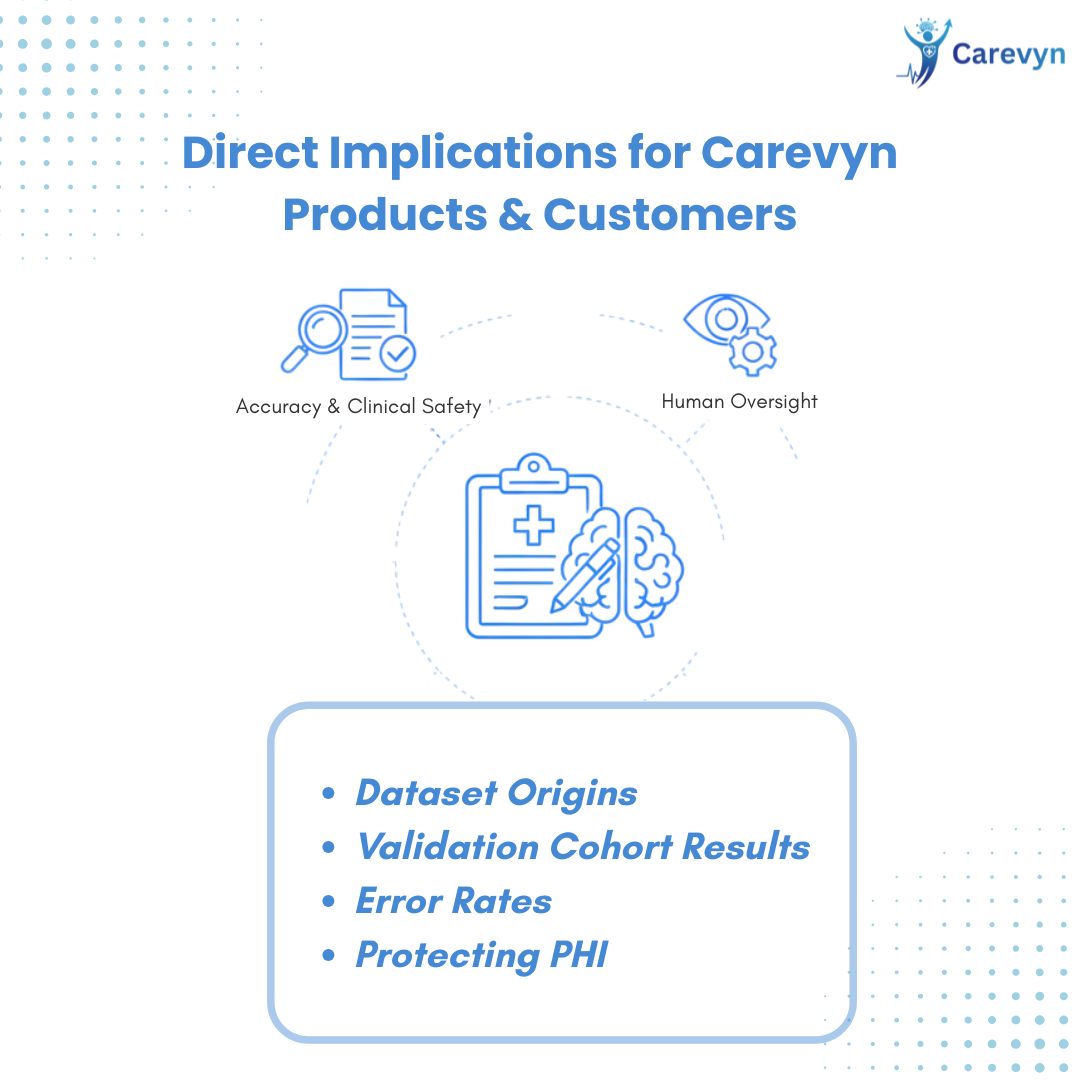
The whole idea here is to speed up how quickly the industry adopts these technologies and cut down on the confusion at state levels. This could mean quicker opportunities for Carevyn, but it also ramps up the pressure to meet federal standards in areas like privacy, safety, and civil rights. - Direct Implications for Carevyn Products & Customers
A. Clinical Documentation & AI Medical Scribe
Expectations are high. Buyers want to see accuracy, clinical safety, and, of course, human oversight. They’ll be looking for logs that track model outputs, edits made by clinicians, and safeguards against any inaccuracies or "hallucinations" from the AI. So, it’s essential to publish a Clinical Safety & Validation Report. This should cover things like dataset origins, results from validation cohorts, error rates in different clinical areas, and how you're planning to tackle any hallucinations or potential leaks of protected health information (PHI).
B. Coding, Risk-Adjustment, and Revenue Tools
Here, the focus is on explainability and the ability to audit outputs that affect claims. If your automation is too vague or comes too early in the process, that's a regulatory red flag. To stay safe, you’ll need to provide Model Cards, detailed input/output audit logs, and have a solid human-in-the-loop policy that ensures every significant code suggestion can be reviewed and timestamped.
C. EHR Integrations & Interoperability
Expectations are all about seamless and secure connections to Electronic Health Records (EHR) and sticking to federal interoperability standards like FHIR and OAuth. Federal clients will lean towards vendors with robust deployment options and proven integration experience. So, be sure to include integration artifacts in your procurement package, like the FHIR resources you’re using, scopes, and connectors for systems like Epic, Cerner, or Athena.
Practical Roadmap — 7 Steps for Carevyn
1. Create a Federal-Ready Compliance Dossier (Weeks 0–4)
Start with gathering all the essential items related to the Executive Order and Action Plan. This includes model cards, summaries of safety tests, handling of PHI, encryption details, data residency, and clinician oversight policies. This is what federal RFPs are asking for most.
2. Operationalize “Safety Testing” & Logging (Weeks 2–8)
You’ll want to set up standardized safety tests, like adversarial prompts and worst-case scenarios, alongside automated logging of model inputs and outputs. Keep everything organized for auditors with reproducible test scripts.
3. Publish Transparency and Bias Assessments (Weeks 4–12)
Get an executive-level bias report out there that discusses the cohorts you tested, how performance varied by patient demographics, and what corrective actions you’ve taken.
4. Offer a Fed-Friendly Deployment Path (Weeks 4–12)
Document your on-prem or GovCloud deployment architecture, and make sure you have a secure data pipeline with least-privilege access and encryption both at rest and in transit.
5. Update Contracts & SLAs (Weeks 4–10)
Make sure to include clauses for incident response and data breach notifications that align with HHS and OMB guidelines, plus support for auditing model provenance.
6. Engage in OSTP/Agency RFIs & Industry Working Groups (Ongoing)
There’s a push for public input on the Action Plan, so get involved in upcoming RFIs and industry standards groups. Being part of this conversation can really help elevate your visibility.
7. Build a Healthcare Safety Board (Weeks 6–16)
Gather a team of clinicians, compliance officers, and an external ethics reviewer to give the green light on any high-risk releases.
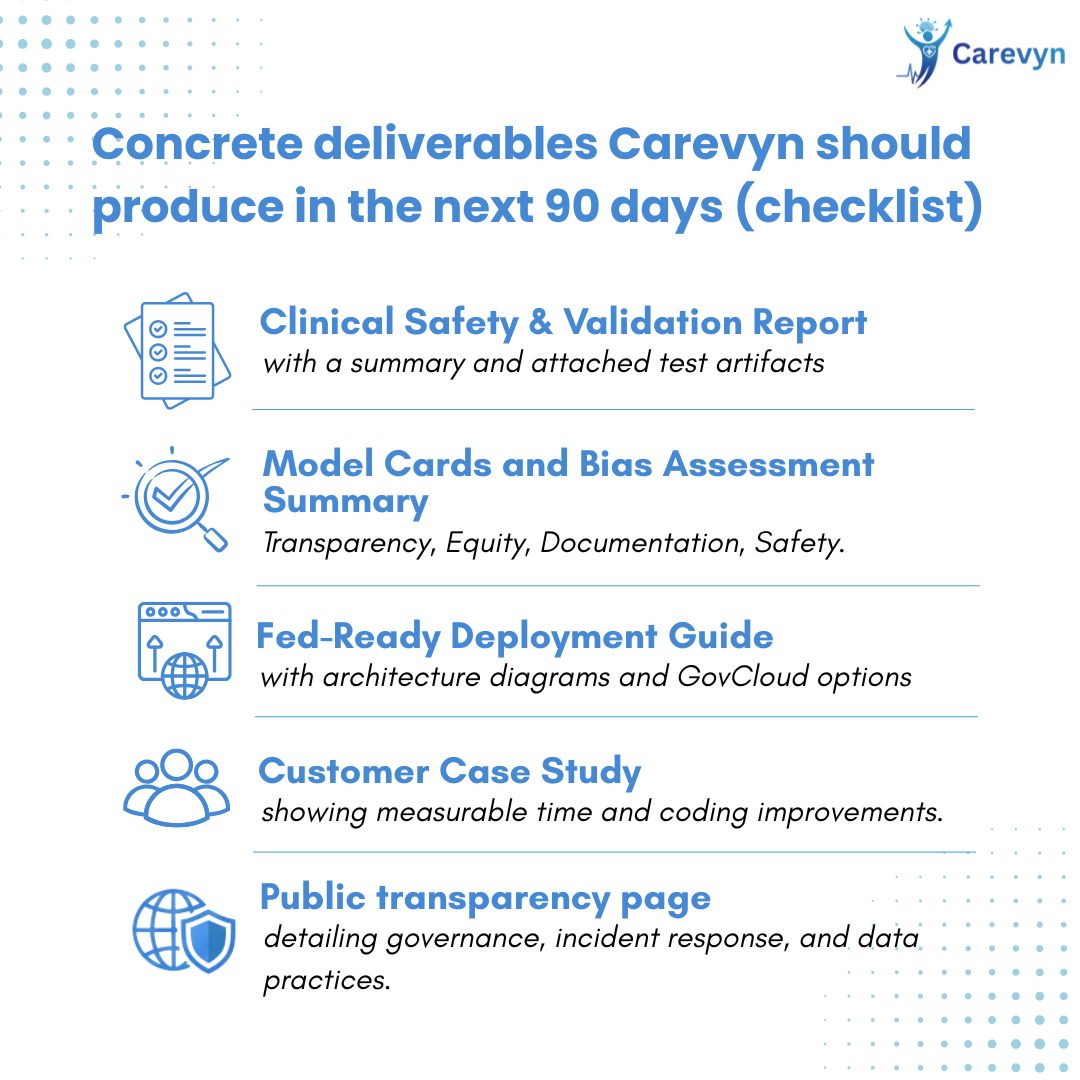
Concrete deliverables Carevyn should produce in the next 90 days (checklist)
1. Clinical Safety & Validation Report (with a summary and attached test artifacts).
2. Model Cards and Bias Assessment Summary.
3. Fed-Ready Deployment Guide (with architecture diagrams and GovCloud options).
4. Procurement Playbook (including SOW, security questionnaire responses, and SLA templates).
5. Customer Case Study showing measurable time and coding improvements.
6. Public transparency page detailing governance, incident response, and data practices.
How does Carevyn turn policy into advantage ?
Be upfront about transparency. Seriously, publish those model cards and safety results! Organizations that are open tend to reduce buyer friction and gain trust. Get your governance in order. Make a process for safety testing and human oversight that you can repeat and audit. Pre-package the materials federal buyers usually request (think security, deployment, and evidence).
Speed is key here!
Engage in policy discussions. Respond to OSTP and agency RFIs — being involved not only raises your profile but also helps shape standards in a way that's favorable for healthcare vendors.
The White House’s AI Action Plan is really changing the game. It’s not about whether AI will be used in government and regulated industries anymore; it’s about figuring out how to do it safely and quickly. For Carevyn, this is a golden opportunity: businesses that can demonstrate safety, auditability, and readiness for integration are going to grab the next wave of federal and enterprise health contracts. So, kick off a focused 90-day plan: publish those safety artifacts, strengthen your deployment options, and whip up those procurement playbooks. You’ll turn compliance into a competitive advantage — trust me!
Frequently Asked Questions :
Q: Will the AI Action Plan force heavy regulation that will block Carevyn’s products?
Not really! The Plan is more about speeding up adoption while keeping some safety measures in place. They actually revisited some of those stricter rules from 2023 in 2025. So, the outcome is more friendly to the industry, focusing on safety evidence and transparency instead of outright bans. Just keep an eye on things and be ready to back up your safety claims.
Q: Should Carevyn stop cloud deployments and go fully on-prem?
Definitely not! It’s better to offer both options. A lot of federal buyers prefer on-prem or GovCloud solutions for handling protected health information (PHI). But you know what? Hybrid setups can work too — as long as you have encrypted processing, limited data flows, and solid logging in place. They can be more scalable, after all.
Q: Does the Plan create funding or incentives we can access?
Yes, it does! The Plan is all about investing in infrastructure and making permits and procurement easier. This opens up chances for partnerships and contracts. So, make sure you register to respond to OSTP and agency RFIs, and keep an eye on those grant portals!
Q: How should Carevyn position itself to hospital CIOs?
Start by highlighting safety evidence, interoperability, and return on investment (ROI). Illustrate how Carevyn meets federal standards for auditability and clinician oversight. And hey, make sure your integration and security details are super easy to understand.